Selected research · 2020
Tracking a path as road conditions change
Adapting vehicle state estimation and predictive control to changing tire–road friction, with simulation, processor testing, and preliminary snow-track experiments.
Problem
A vehicle controller needs to predict how steering and acceleration will change the vehicle’s motion. Those predictions depend on the forces between the tires and the road. A model that works on asphalt can become a poor guide on snow, even when the requested path has not changed. The engineering challenge is to adapt the predictions while continuing to control the vehicle.
Learning a complete tire-force model directly from driving data presents a difficulty: revealing the tire’s behavior near its limits can require maneuvers that are undesirable before the controller has a reliable model. The study addresses this tension between identifying the dynamics and using them for control.
Approach
The method combines nonlinear model predictive control with a noise-adaptive particle filter. The filter estimates vehicle state and tire stiffness from measurements. The controller uses these estimates to select a tire model from a predefined library.
The stiffness estimate describes the approximately linear part of the tire response during normal driving. A relationship between that stiffness and the nonlinear tire behavior guides the selection of a full model from the library. The predictive controller uses the selected model when calculating its next control action.
Results and validation
The paper evaluates the method through simulation with real vehicle parameters, tests real-time feasibility on automotive-grade processors using a rapid-prototyping unit, and reports preliminary experiments on a snow-covered test track.
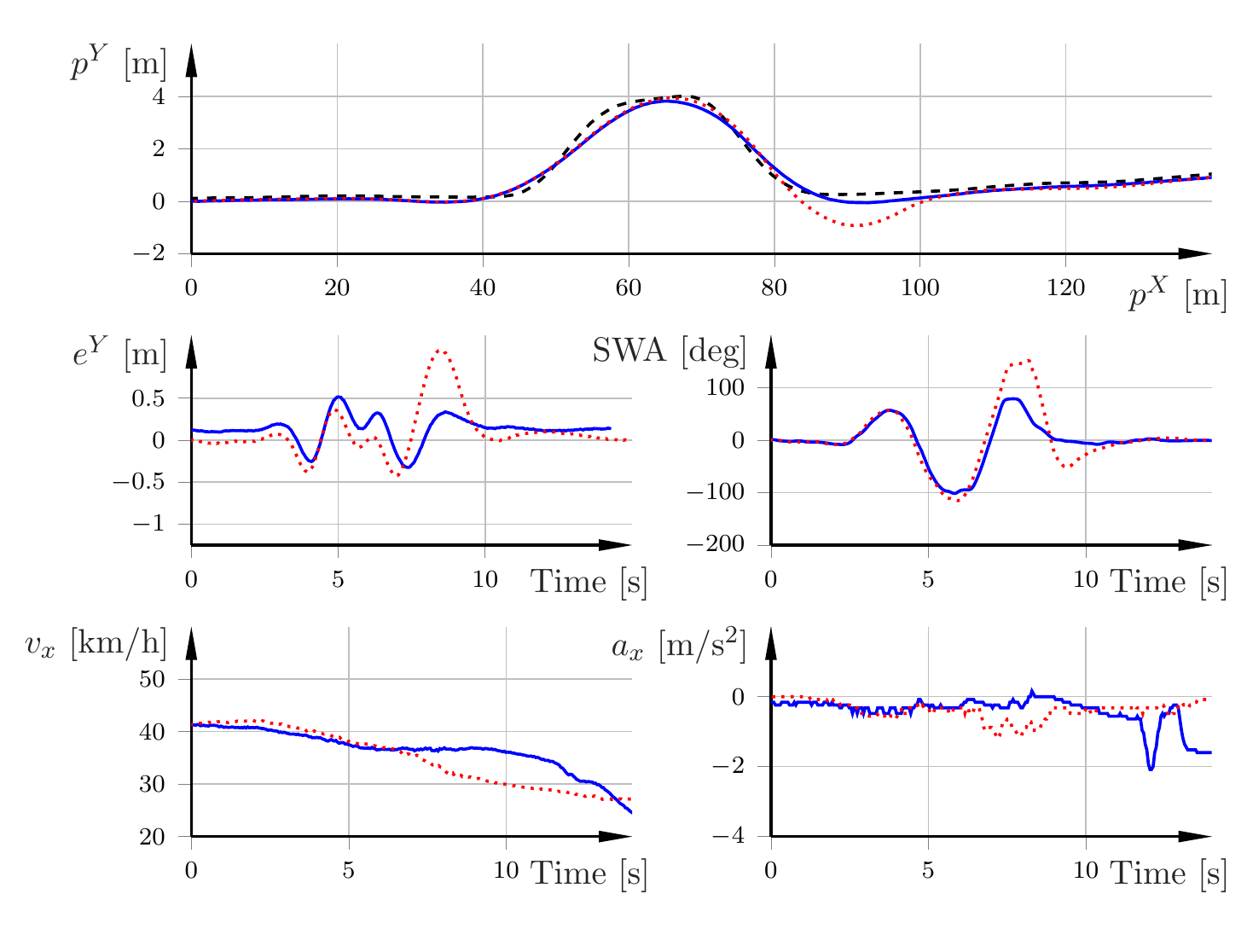
The figure shows one experimental double lane change. In that test, the friction-adaptive controller followed the reference more closely than the controller using an asphalt tire model.
Publication
Trajectory Tracking for Autonomous Vehicles on Varying Road Surfaces by Friction-Adaptive Nonlinear Model Predictive Control
Vehicle System Dynamics · 2020
View bibliography entry